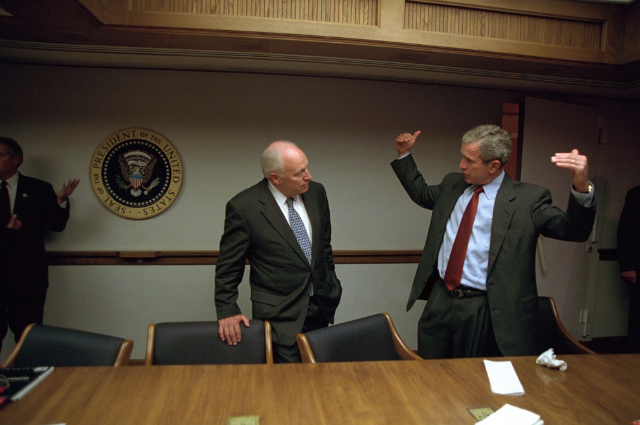
The news broke quietly on a gray November morning as polls opened around the country. Richard B. Cheney, known to the world as Dick, former vice president under George W. Bush and a man who once stood at the heart of American power, was dead. For many, his name still echoes through history’s darker moments: Iraq, the Guantanamo Bay detention center, and the PATRIOT act. For others, it recalls a steady hand through history, a vice president who stood for order when the world seemed to fall apart. 16 years after leaving office, and even in death, his legacy remains a complex story. As we reflect on the life of Vice President Cheney, we ask ourselves one simple question: guardian or antagonist?
To his allies, Cheney represented conviction and control. In a statement, former President George W. Bush called Cheney a “decent, honorable man” and “among the finest public servants of his generation.” For Bush, Cheney was his trusted rock, a quiet backbone for an administration constantly tested by crisis and controversy. But for many others, his record tells a different story: one of a government that learned to justify overreach in the name of safety.
As the nation reeled from the attacks of Sept. 11, Cheney became the lead architect of an expansive ‘War on Terror.’ His decisions helped launch the Iraq war, justified the use of enhanced interrogation techniques, and reshaped the balance between security and privacy. He wielded the typically ceremonial powers of the vice presidency as a command post, redefining what power looks like from closed doors.
AP World History teacher Anne Sharkey says that legacy is precisely what makes Cheney so significant.
“He is undoubtedly the VP in recent history with the most influence and reshaped the potential influence of that role,” Sharkey said. “His legacy continues with the impacts of these decisions as Middle Eastern politics play out today.”
That influence, she noted, is both his achievement and his burden.
For younger generations, Cheney is less a man than a shadow.
“Honestly, I only knew who he was because of that hunting accident story,” sophomore Morgan Schmitt said. “Most people our age don’t pay attention. They just repeat what their parents say or what they see online.” Schmitt’s comments show just how disconnected the wars and controversies of the early 2000s already feel from the present day, and how easy it feels for lessons of that era to slip through the cracks as time goes by.
However, those lessons are still being written. The systems Cheney helped build: a complex web of surveillance networks, indefinite detentions, and the normalization of executive secrecy, have all embedded themselves into governance today. Whether he is remembered as a patriot or a manipulator, his influence endures. Cheney believed he was protecting the nation; history may remember him as testing the boundaries of our democracy by himself.
In the end, perhaps Dick Cheney’s story is not one of good or evil. Rather, it is about the dangerous comfort of remaining in certainty. He believed his actions made America safer, and perhaps they did. However, safety purchased without scrutiny is its own kind of risk. It all comes down to our generation to either embrace or reject the legacy and precedent set by the backseat driver with an iron grip.
But, for now, one month after the fact, we reflect on the life and service of a man who valued his country over any party. A tactician who pulled the levers of power from just offstage. The wars, the fear, the certainty: they live on and outlast him like a never-ending tape reel that never has an end-credit. This chapter of America’s political story is over, but the larger film continues, and we inherit the frame he left behind.