
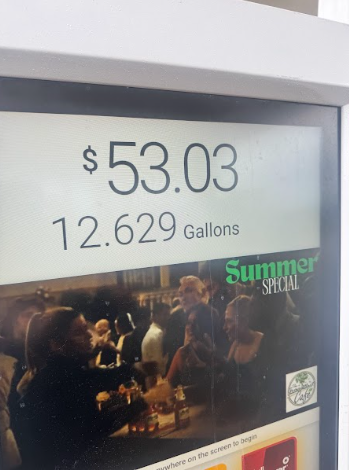
When you go to the gas station to fill up your car, you may see a number on the screen that your mind can not comprehend; hours of your paycheck just went to getting yourself around town. You drive your car to the grocery store, and you realize the cost of food has skyrocketed. No matter where you go, the money you spend on goods and services has risen dramatically.
High inflation creates an economic domino effect: high prices, decreased disposable income, less spending, and less demand for goods in the macroeconomy. In combination with poor economic decision-making at the federal level, Americans’ incomes are bleeding dry.
The incline in gas prices has made the necessity of transportation more costly to obtain.
“My gas has gone up about $10 compared to a few months ago,” senior Mason McCoy said. “For me, [a full tank] is $40 when it used to be $30.”
In a country where a car is almost a requirement for daily life, an increase in gas prices is something one can not avoid. While cost-cutting measures can help save money, in terms of fuel, saving money is practically impossible.
Gas prices are also following an upward trend in the American economy: everything has gotten more expensive. As HHS seniors leave high school and enter their post-secondary life, they are inheriting an economy that works against them.
“My dad will talk to me about how he’s concerned not only for the cost of college … but also the cost of living after college,” senior Ricki Alvarez said. “He’s worried that I’m not going to be able to pay off my student loans because [the economy] is going to be harder.”
As price levels in the United States continue to increase, so will the difficulty of being financially stable. Higher prices in living costs, along with other goods, means less extra income for Americans to spend; and as a result, money spent on things they want and enjoy will diminish.
When disposable income is low, consumers try to maximize it by shopping at more affordable places. Even in places where affordability is advertised—like thrift stores—their prices now match the average department store.
“When I am at Saver’s, sometimes I’ll pick up a shirt and it will be $20,” senior Hailey Van Alstine said. “[The shirts] are cute, but not $20 cute.”
Although thrifting meant finding clothes at a bargain price; nowadays, that is no longer the case. As upkeep for stores gets more costly and donations dwindle, a lower quantity of clothes jumps up the price.
One of the biggest reasons as to why the prices of everything has increased is because of the recent tariff implementations. If a government puts a tariff above the price that goods are traded for, the amount of that good being imported will decrease drastically. As less goods are imported, the supply of this good decreases, causing the price to become inflated. While tariffs do increase government tax revenue, it comes at the cost of inflation and heightened scarcity of goods to consumers.
Even foreign policy overseas can affect the domestic economy adversely. With the start of the Iranian-American conflict, exports of gasoline by Middle Eastern countries into the US dwindled to zero. American and Israeli forces also forced the shutdown of the Strait of Hormuz, a checkpoint where 20% of oil and gas cross through.
Because of this halt in natural gas imports, this artificially spiked the price of natural gas. When a resource like gas’s cost increases, producers of goods cut back on their production. As a result, goods become more scarce and more expensive in their respective markets.
To conclude, poor economic policy by the federal government along with consistent inflation has made the economy a shell of its former self. In turn, Americans nowadays feel the pressure of a bleeding economy; an economy in which affordability and macrostability are things of the past.