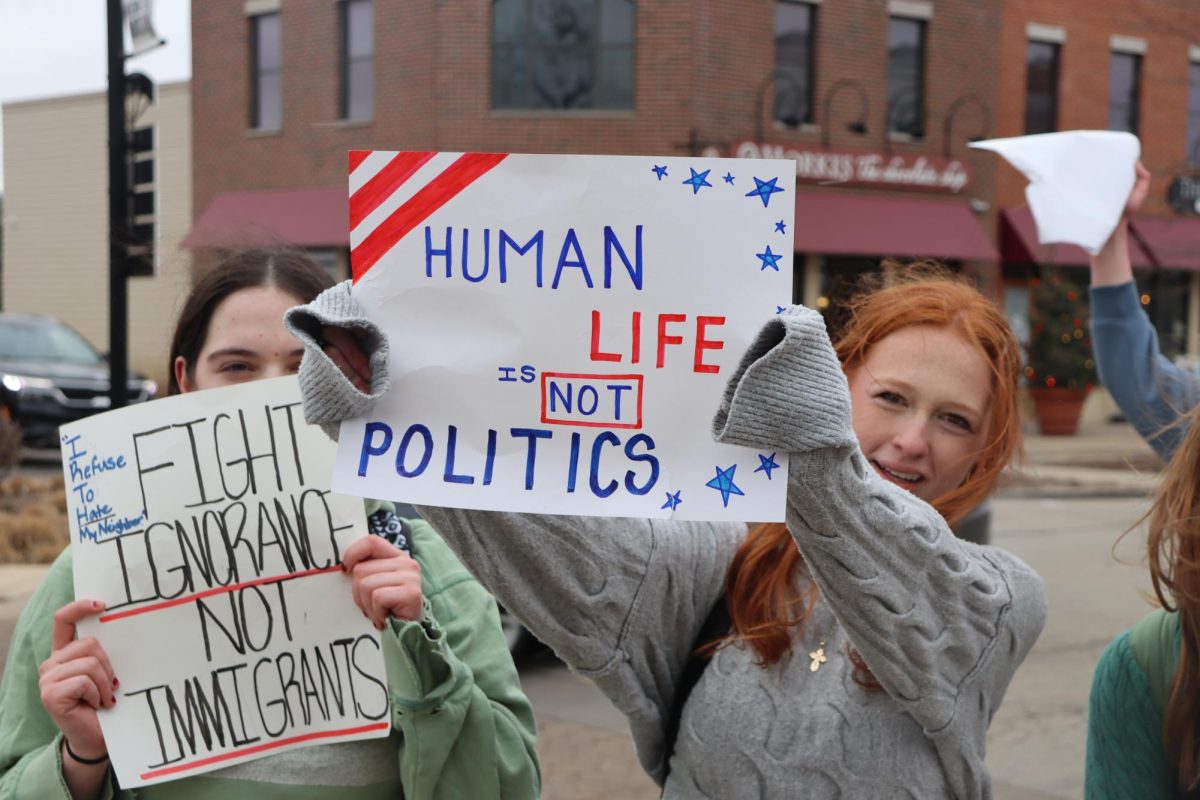
What began as a peaceful student walkout on Feb. 20 to protest Immigration and Customs Enforcement operations quickly turned into a controversy over discipline, as students returned to school to find consequences that didn’t seem to follow a clear or consistent standard. In the days following the protest, reports of uneven punishments spread, raising questions not just about the severity of the discipline, but about how or why those decisions were made.
Most underclassmen received two after-school detentions, a relatively severe baseline punishment. Upperclassmen without off-campus privileges were generally given the same consequence. But for others, the outcome varied: some upperclassmen who left campus received only a single detention, while at least one junior reported receiving no consequence at all, despite missing multiple periods.
Senior Sofija Graba said the lack of clarity stood out.
“There was no clear explanation,” Graba said. “If there had been a clear explanation, it might have felt more justified. Without one, it just feels like, ‘Here is the punishment. Go serve it.’”
Graba, like other seniors, did not receive a traditional detention. Instead, because the walkout resulted in an unverified absence, she is now required to take final exams at the end of the year. Something that is typically waived for seniors who meet attendance expectations.
“Technically, that is a consequence,” she said. “The rule for seniors is that if you have one unverified absence, you have to take finals.”
For underclassmen, the consequences were more immediate. Sophomore Lia Demetry was assigned two after-school detentions after leaving campus without privileges.
“They said it was because I went off campus when I don’t have off-campus privileges,” Demetry said.
While Demetry felt the reasoning behind her discipline was clear, she questioned how consistently it was applied.
“I think it’s strange that juniors and seniors who have off-campus privileges still get detentions even though they are allowed to leave campus normally,” she said.
Other students echoed a similar mix of understanding and uncertainty. Sophomore Jake Bollman said he expected some form of discipline but was surprised by the severity.
“I thought maybe the first off-campus violation would be something like a lunch detention rather than two full after-school detentions,” Bollman said.
Several students also pointed to a lack of communication before and after the walkout. While many assumed there would be consequences for skipping class, specific outcomes were not clearly outlined in advance.
“Maybe they could have told us beforehand that if we left campus, we would get detentions,” Bollman said. “If I had known that, I might still have done it, but at least I would have known.”
Communication after the fact also varied. Some students were called down individually and given written notices, while others reported only seeing their consequences appear in the attendance system, without direct explanation.
“I did not receive any email or direct communication,” Graba said. “It was just listed in the attendance system.”
Despite differences in discipline, students consistently described the walkout itself as peaceful. Participants walked several miles in cold weather, gathered at Huntley Square, and returned without incident.
“It was not violent or aggressive in any way,” Graba said. “I’m proud of the people who stood up and did something difficult.”
The Voice reached out to District 158 administrators, including Dean Justin Stroh and Chief Safety Officer Adam Dean, for clarification on how disciplinary decisions were made. They did not respond to requests for comment.
In the absence of clear communication from administrators, students are left to interpret the consequences on their own. Many say that’s where the frustration lies. While most expected some form of discipline, the lack of transparency and consistency has overshadowed the walkout itself, shifting the conversation from why students protested to how administrators chose to respond.