
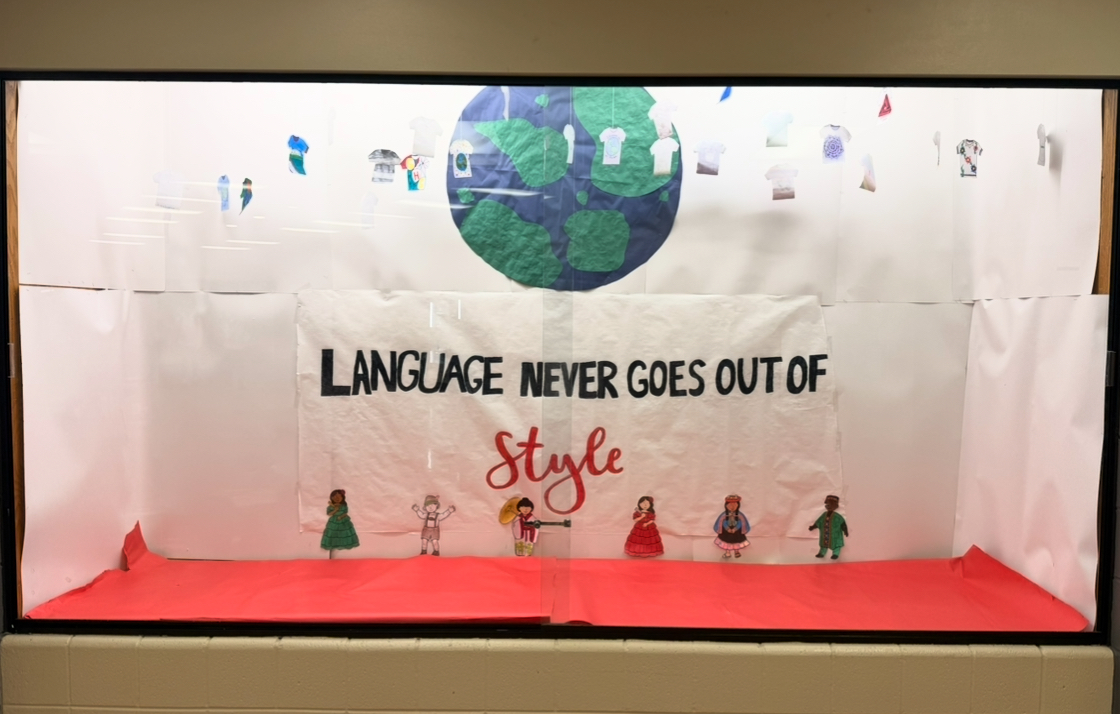
From looking at the display case in the hall to finding Waldo in the Spanish classes, World Language Week has connected the community in more than one way.
Schools in the United States have been participating in World Language Week since 1957, and this is the third year that Huntley’s Spanish Honor Society has taken on the task of setting it up.
“World Language Week is a celebration of not only the languages we teach here at Huntley High School, but the languages that lots of kids may speak at home or any cultures that they may be a part of,” advisor and Spanish teacher Katie Goss said.
The week strives to connect and share different cultures and languages. As Goss mentioned, many students at HHS have other languages or cultures that are different from American students.
This highlights places and cultures from all over the world to educate and represent students.
Sage Aschenbrenner, a junior and the World Language Chair for Spanish Honor Society, created this year’s theme.
“I created the theme, [and] I actually was inspired in Costa Rica,” Aschenbrenner said. “One of [my] Costa Rican [friends] gave me the idea to do ‘language never goes out of style,’ so that’s where that comes from.”
The activities for World Language Week heavily involve the students. There are activities like “Find the Flag” and “Where’s Waldo,” and during passing periods, the songs that play correlate to that day’s country.
“Me and my group have developed paragraphs for the ‘Where’s Waldo’ competition where students have to guess which country Waldo is in,” Spanish Honor Society president Will Davis said.
“Find the Flag” works in a similar manner, where students will have to find flags in their classrooms that they can turn into Goss for candy.
Students can also get involved outside of World Language Week.
With clubs like the Black Student Union, the Chinese Club, the Latino Coalition, and more, students can join without being in that specific culture. Global Academy and social studies classes also expose students to other cultures and parts of the world.
“Most students have some connection to a different part of the world, so they can even hopefully just appreciate the declaration and the display case and feel like they’re a part of something bigger,” Goss said.
